
IBE Hair Extensions vs Hand-Tied vs Tape-In: Which Is Right for You?
Choosing hair extensions can feel confusing because method names are often used as though they mean the same thing. A clear IBE hair extensions vs hand-tied comparison starts by separating product type from installation method. The comparison between IBE hair extensions vs hand-tied methods becomes much clearer once you understand that “hand-tied” usually describes a type of weft or a broad category of weft installation, while IBE® refers to Invisible Bead Extensions®, a specific patented installation method that uses wefts and hidden beadwork.
Tape-in extensions are a different system altogether. They use thin adhesive tabs to sandwich small sections of natural hair, making them faster to install and easier to try without committing to a full weft transformation.
The best choice depends on your starting hair, desired length and volume, scalp sensitivity, styling habits, budget, maintenance schedule, and how often you swim or spend time outdoors in 30A’s humid, salty climate. This guide compares the three options honestly so you can arrive at an extension consultation with realistic expectations.
First, What Does IBE Hair Extensions vs Hand-Tied Actually Mean?
The phrase IBE hair extensions vs hand-tied can sound like a comparison between two completely separate extension products, but the categories overlap.
Invisible Bead Extensions® describes IBE as a specialized hand-tied extension method created to address common issues found in other weft installations. The method focuses on hidden beadwork, balanced tension, and stitching designed to keep the attachment points less visible when the hair is worn up. Invisible Bead Extensions® official method information explains that IBE is a method and certification system, not an individual keratin-bond extension.
Traditional hand-tied extensions usually involve rows of beads or thread that support hand-tied or lightweight wefts. The exact placement, stitching pattern, number of rows, and tension can vary by stylist and method. A responsible IBE hair extensions vs hand-tied consultation should explain those differences before installation.
Tape-ins use pre-taped panels. A stylist places a small section of natural hair between two extension tabs, creating a flat attachment that can blend well when correctly installed.
This distinction matters because the skill of the stylist and the installation pattern can affect comfort and wear just as much as the extension hair itself.
Quick Comparison: IBE Hair Extensions vs Hand-Tied vs Tape-In
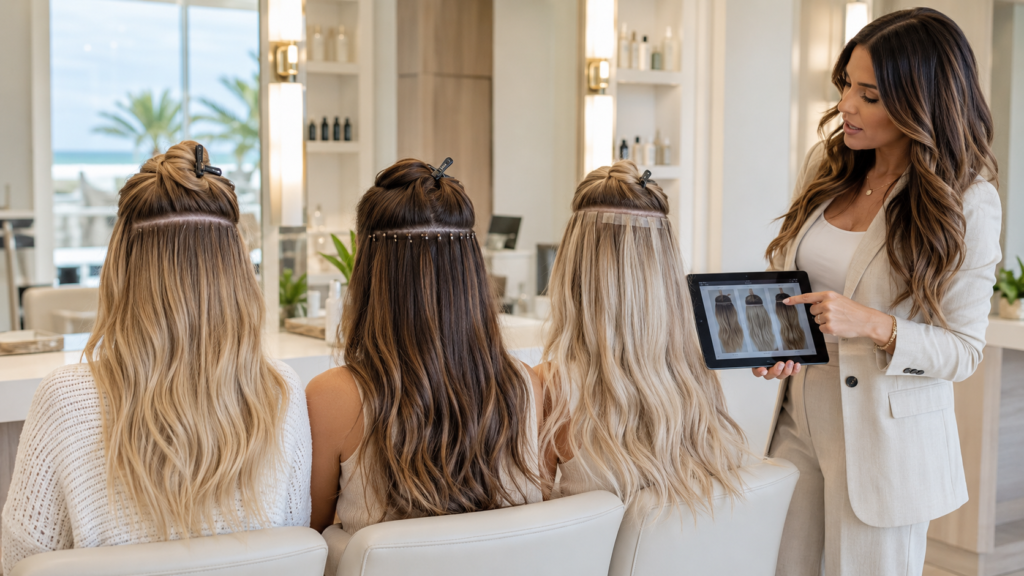
Traditional hand-tied wefts are usually chosen for significant volume, length, and natural movement. They can be customized with different row placements and amounts of hair.
IBE is a branded, certified approach to weft installation. It is often selected by guests who want discreet attachment points, comfortable wear, and styling flexibility, especially when wearing ponytails or updos.
Tape-ins are lightweight, quick to install, and often less expensive at the initial appointment. They are popular with first-time extension guests and people who want moderate volume without committing to multiple rows of wefts.
In practical terms, the IBE hair extensions vs hand-tied decision is usually about installation technique and tension distribution. The hand-tied vs tape-in decision is more about choosing between a sewn weft system and adhesive panels.
Traditional Hand-Tied Wefts: Best for Custom Volume and Length
Hand-tied wefts are thin curtains of extension hair that are attached to a beaded foundation and sewn into place. Traditional IBE hair extensions vs hand-tied questions often begin with how that foundation is built. The word “hand-tied” commonly describes how the weft is constructed, although salons sometimes use it as a general name for the installation service.
A skilled stylist can customize the number of rows, weft density, placement, color blend, and perimeter coverage. This makes the method useful for guests seeking a substantial transformation.
Who Is a Strong Candidate?
Hand-tied extensions can work well for guests with fine-to-medium or medium-to-thick hair, provided there is enough healthy natural hair to support and conceal the rows.
They are often ideal for someone who wants noticeable length and volume, regularly styles the hair down or in loose updos, and is comfortable returning for scheduled move-up appointments.
Main Advantages
The hair can move naturally because the weft distributes length across a row rather than attaching every strand individually. Properly selected wefts can create fullness without the bulky appearance associated with older extension systems.
Wefts are reusable through multiple move-up appointments when the hair remains in good condition. They can also be custom-colored by an experienced extension colorist.
Important Tradeoffs
The first appointment can take several hours, particularly when color matching, cutting, blending, and multiple rows are involved.
Sleeping, brushing, washing, and drying require a consistent routine. Skipping maintenance can allow the grown-out row to twist, tangle, or place uneven tension on natural hair.
When comparing IBE hair extensions vs hand-tied, remember that a traditional hand-tied installation can be excellent when the stylist has a safe, consistent row method. The method name alone does not guarantee a healthy result.
IBE Extensions: Best for a Discreet Certified Weft Method
IBE stands for Invisible Bead Extensions. It is not an abbreviation for individual bond extensions. IBE uses wefts, beads, and stitching, but the certified method is designed to conceal the beads and create a balanced row.
The IBE hair extensions vs hand-tied comparison therefore resembles comparing a specialized installation system with a wider family of weft installations.
Who Is a Strong Candidate?
IBE may appeal to guests who frequently wear their hair in ponytails or updos, are concerned about visible attachment points, or have previously experienced discomfort with another row method.
It may work for a range of densities, but every candidate still needs an in-person assessment. Very fragile, actively shedding, severely damaged, or extremely sparse hair may not safely support the desired amount of extension hair.
Main Advantages
The concealed foundation is intended to make the rows less obvious from underneath. The method also emphasizes tension control and row construction.
Because IBE is a certification-based method, guests can ask whether the stylist is currently certified and how frequently the stylist performs the service.
Important Tradeoffs
IBE is still a maintenance commitment. Hidden beads do not eliminate the need for careful brushing, thorough drying, regular move-ups, and scalp monitoring.
The initial investment may be similar to or higher than other premium weft services because the appointment requires specialized training, precision, customization, and substantial salon time.
The fairest way to approach IBE hair extensions vs hand-tied is not to assume one is automatically superior. Ask which row method the stylist recommends for your density, scalp, desired result, and maintenance habits.
Tape-In Extensions: Best for Speed and Lower Commitment
Tape-ins use thin adhesive tabs placed in small sections throughout the hair. Unlike the IBE hair extensions vs hand-tied comparison, tape-ins change both the attachment format and maintenance routine. The panels lie flat and can add volume, length, or targeted fullness.
Application is generally faster than a full weft installation. Removal and reinstallation are also relatively efficient when performed correctly with professional products. This is one reason the IBE hair extensions vs hand-tied vs tape-in decision often depends on appointment time and commitment level.
Who Is a Strong Candidate?
Tape-ins are often a good first extension experience. They suit guests seeking moderate fullness, a shorter appointment, or a more accessible initial investment.
They can also work for fine hair because individual panels are lightweight, although placement must be thoughtful so the tabs remain hidden.
Main Advantages
Tape-ins create flexible placement. A stylist can add a few panels around the sides for density or install a larger set for overall length.
The method does not require a stitched row. This may appeal to someone who prefers smaller attachment points distributed across the head.
Important Tradeoffs
Oil, heavy conditioner, sunscreen, and certain styling products near the tabs may weaken the adhesive. Guests must be disciplined about keeping slippery products away from the attachment area.
Tape panels may become visible in very high ponytails or loosely secured updos if placement and natural coverage are limited.
Humidity itself does not automatically release professionally installed tape-ins, but repeated moisture, saltwater, inadequate drying, and product buildup can shorten wear. Tape-ins therefore require special attention during a 30A summer.
Comfort and Scalp Tension
Comfort is one of the most important factors in the IBE hair extensions vs hand-tied decision. No method should create ongoing pain, headaches, burning, sores, or intense pulling. Any IBE hair extensions vs hand-tied recommendation should put scalp comfort ahead of maximum length.
The American Academy of Dermatology warns that repeatedly wearing styles that pull tightly, including extensions and weaves, can contribute to traction alopecia. AAD guidance on hairstyles that pull recommends loosening any style that causes pain or irritation.
A little awareness during the first days is normal because the hair feels different, but persistent pain is not something to “push through.” Contact the salon promptly if a row, bead, or panel feels excessively tight.
Traditional hand-tied and IBE rows distribute hair across a horizontal foundation. Tape-ins distribute smaller amounts across multiple panels. Neither format is automatically tension-free; correct weight selection and placement are essential.
Which Method Looks the Most Natural?
All three can look natural when the color, density, length, texture, installation, and haircut are correct. Appearance alone should not decide an IBE hair extensions vs hand-tied choice.
Traditional hand-tied wefts are especially strong for creating continuous fullness through the back and sides. They can support dramatic length while maintaining soft movement.
IBE is designed to make the row foundation discreet, which can benefit guests who like high ponytails, half-up styles, or exposed underneath sections.
Tape-ins can look nearly invisible when the tabs are placed beneath enough natural hair. They are particularly effective for filling fine sides and creating moderate length.
The most natural method is ultimately the one your natural hair can conceal and support. During an IBE hair extensions vs hand-tied consultation, ask the stylist to show where the rows or panels would sit on your own head. A visual IBE hair extensions vs hand-tied demonstration is more useful than choosing from method names alone.
Maintenance Schedule and Move-Up Timing
Most weft installations require a move-up approximately every six to eight weeks, although growth rate, density, lifestyle, and stylist protocol may change the timing. Maintenance consistency matters in every IBE hair extensions vs hand-tied plan.
Tape-ins commonly require removal and reinstallation around six to eight weeks as the natural hair grows. Waiting too long increases tangling near the roots and makes the panels harder to conceal.
Initial extension hair can often be reused through several appointments if it is high quality and cared for correctly. Replacement timing depends on heat exposure, product use, brushing, swimming, color work, and everyday wear.
The IBE hair extensions vs hand-tied maintenance schedule may look similar on the calendar, but the move-up procedure can differ because the row construction and certification protocol differ.
Never book extensions if regular maintenance is not realistic. Delaying move-ups is one of the fastest ways to turn a beautiful service into matting, discomfort, and unnecessary stress on natural hair.
Realistic Cost Ranges
Extension pricing is customized because the cost depends on hair quality, length, color, number of rows or panels, density, installation time, blending, and whether custom color is needed. That is why IBE hair extensions vs hand-tied pricing cannot be reduced to one universal number.
Halo’s existing extension guidance places a full premium hand-tied transformation in a broad initial range of roughly $1,500 to $4,000 or more, with move-ups commonly around $200 to $400. A volume-only transformation may cost less, while extra-long or high-density work may cost more.
IBE pricing may fall within a similar premium range because it is a detailed weft installation performed by a trained stylist. Exact pricing should follow a consultation and should confirm whether the quote includes extension hair, custom coloring, installation, haircut, blending, and take-home care.
Tape-ins often have a lower entry point because application can be quicker and the amount of hair can be scaled in smaller increments. A partial volume service may begin in the high hundreds, while a full custom length transformation can move well above $1,000.
When evaluating IBE hair extensions vs hand-tied pricing, compare the entire first-year cost rather than the installation alone. Include move-ups, removal, replacement hair, color maintenance, treatments, brushes, and home care.
How the Methods Handle 30A Humidity, Swimming, and Salt Air

Human-hair extensions respond to humidity much like natural hair. They may expand, frizz, curl, or lose a smooth finish depending on their texture and porosity.
A texture match matters. Very straight extension hair attached to naturally wavy hair can require constant heat styling during humid months. A compatible texture usually blends more naturally as both types of hair respond to the weather.
Swimming is possible with professionally installed extensions, but no method is maintenance-free in saltwater or chlorinated water. Wet the hair with fresh water before swimming, apply a stylist-approved leave-in product through the lengths, and secure the hair in a loose braid.
After swimming, rinse promptly with fresh water and dry the attachment area thoroughly. Never sleep with wet extensions.
For tape-ins, keep oils and heavy conditioners away from the adhesive tabs. For hand-tied or IBE rows, make sure the weft and bead area are completely dry to reduce tangling and moisture buildup.
The IBE hair extensions vs hand-tied comparison does not produce one universal winner for swimming. Your aftercare discipline matters more than the marketing label.
Best Option for Fine Hair
Fine hair requires conservative weight and excellent concealment. Tape-ins can work well because individual panels are lightweight and placement can be customized.
A single lightweight hand-tied or IBE row may also create natural volume when there is enough healthy hair to support it. The stylist should resist adding more hair than the natural density can safely carry.
The best IBE hair extensions vs hand-tied decision for fine hair depends on the strength of the perimeter, density through the sides, shedding history, and styling goals.
Guests with active hair loss, scalp irritation, unexplained thinning, or significant breakage should pause and seek medical guidance before committing to extensions.
Best Option for Thick Hair
Thick hair can conceal rows and panels easily, but it may require more extension hair to create a seamless length transformation.
Hand-tied and IBE rows are efficient for adding substantial length because they distribute large amounts of hair across organized foundations.
Tape-ins can still work, but achieving a full transformation may require many panels and a longer removal process.
For thick hair, the IBE hair extensions vs hand-tied choice may come down to the preferred row technique, updo visibility, scalp comfort, and the stylist’s expertise.
Best Option for Active Lifestyles
Guests who exercise frequently, swim, travel, or wear ponytails need a method that fits those habits.
IBE may appeal to active guests because the hidden foundation is designed with versatile styling in mind. Traditional hand-tied rows can also perform well when placed strategically.
Tape-ins are convenient but require careful product placement and diligent drying. Sweat, sunscreen, and oil near the tabs should be managed carefully.
No extension method should remain wet for hours after swimming or exercise. Dry the roots and attachment points, detangle gently, and follow the salon’s care instructions.
Best Option for First-Time Extension Wearers
Tape-ins are often the easiest entry point because a partial set can create visible fullness without the cost or appointment length of a multi-row transformation.
A first-time guest who wants dramatic length may still prefer hand-tied or IBE, especially when the salon provides a thorough consultation and realistic maintenance plan.
The IBE hair extensions vs hand-tied conversation should include how you normally style your hair, whether you can avoid sleeping with wet hair, and whether move-up visits fit your schedule.
Starting with less hair is often wiser than choosing the maximum transformation immediately. You can add density later after learning how extensions feel and behave.
How to Protect Your Natural Hair
Healthy extensions begin with a healthy installation. The stylist should assess the scalp, density, breakage, chemical history, and current shedding before selecting a method.
Brush with an extension-safe brush while supporting the attachment area. Begin at the ends and work upward without pulling aggressively.
Wash as directed and rinse thoroughly. Conditioner and masks belong primarily on the mid-lengths and ends unless the stylist recommends otherwise.
Use heat protection and avoid clamping hot tools directly onto tape, beads, bonds, or stitching. Sleep with dry hair in a loose braid or low ponytail.
If the scalp becomes painful, develops sores, or shows thinning around attachment points, contact the salon. The safest IBE hair extensions vs hand-tied result is one that protects the natural hair throughout wear, not just on installation day.
Questions to Ask at Your Extension Consultation
Ask which method the stylist recommends and why. The explanation should connect directly to your hair density, condition, goals, lifestyle, and budget.
Ask whether the stylist is certified in the named method. IBE is a specific certification-based system, so using the name should mean more than offering a generic hidden-bead row.
Ask how much hair is recommended, how many rows or panels will be used, and how the extensions will be color-matched and blended.
Confirm the initial cost, move-up cost, removal cost, maintenance interval, estimated lifespan of the hair, cancellation policy, and deposit requirements.
Discuss swimming, exercise, humidity, frequent ponytails, medications, hair loss history, and upcoming color appointments.
A clear IBE hair extensions vs hand-tied consultation should leave you understanding the plan, not feeling pressured into the most expensive option.
What to Expect at Halo’s Extension Consultation
Bring inspiration photos, but also be ready to discuss what you dislike about your current hair. Volume, length, side density, breakage, and color correction require different extension strategies.
Your stylist should examine your natural hair and scalp, review your routine, and explain which methods are currently available at Halo. The consultation should also clarify whether IBE is being offered as the certified Invisible Bead Extensions method.
The stylist can then estimate the amount of hair, appointment length, maintenance frequency, home-care routine, and full investment.
Color matching may involve more than choosing one shade. Dimensional hair often needs blended colors so the extensions disappear into the natural hair.
Final Verdict: IBE Hair Extensions vs Hand-Tied vs Tape-In
Choose traditional hand-tied wefts when you want customizable rows, substantial volume or length, natural movement, and a premium reusable system.
Choose IBE when you want a specialized certified weft method focused on hidden beadwork, balanced rows, and flexible styling.
Choose tape-ins when you want faster installation, scalable volume, a lower-commitment first experience, or a potentially lower initial investment.
There is no method that is best for everyone. The right IBE hair extensions vs hand-tied recommendation depends on your hair’s ability to support the extension weight, the result you want, and how consistently you can maintain it.
Book an extension consultation at Halo Salon 30A for a personalized IBE hair extensions vs hand-tied comparison before committing to installation.